SIGNAL CHOIR
A living data-art system that turns real-time datasets into glowing vertical forms — and then lets you hear them.
Concept / self-initiated — this project was created by Elentara as independent research and was not produced for a client.
Challenge
Most live dashboards are read once and ignored. The information is present but it has no presence. This concept asks whether a dataset can be given a body and a voice without becoming dishonest about what it measures.
Idea
Give every data point a vertical form and four honest mappings: magnitude to height, intensity to brightness, rate of change to motion, and value to pitch. Because the mappings are strict and consistent, the piece can be learned — and once learned, heard.
Experience
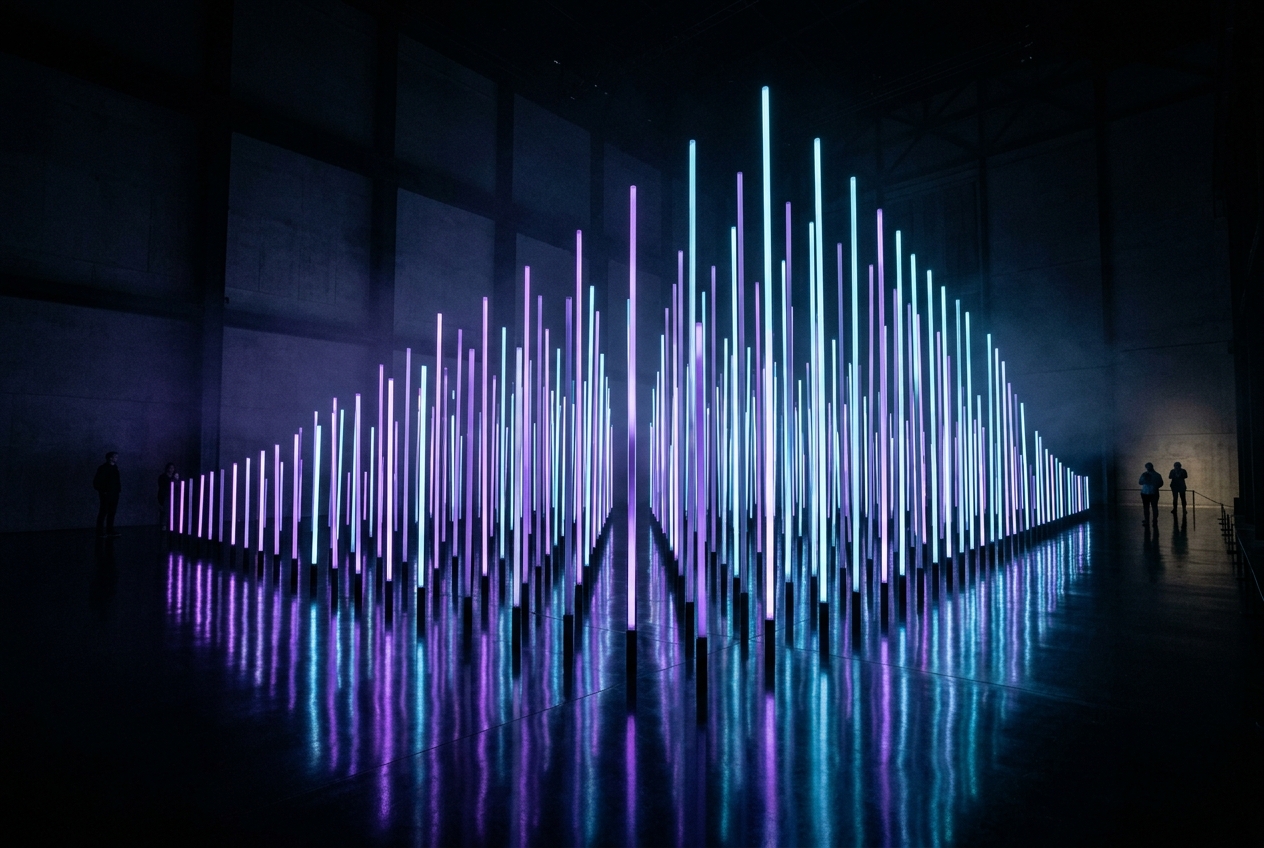
The visitor faces a field of light columns that shift as the feed updates. Hovering isolates a column and brings its tone forward; the whole field can be played as a chord. Anomalies announce themselves as both a spike and a dissonance, which is faster than reading any chart.
Design Direction
A vast dark plane, cold cyan and violet emission, atmospheric haze for depth. Nothing is drawn that is not data — no axes, no gridlines, no decorative particles. Type appears only as a mono readout when a column is isolated.
Technology
- Streaming dataset ingest with normalisation and outlier handling
- Instanced GPU rendering for thousands of concurrent forms
- Web Audio synthesis mapped from value to pitch
- Muted, motion-reduced mode with the same visual encoding
Process
- Mapping honesty review — ensuring encodings cannot mislead
- Perceptual tuning for brightness and height ranges
- Sonification study to keep harmony legible at scale
- Accessibility pass: audio optional, encoding never audio-only
Outcome
A self-initiated study in giving data presence. Conceptual, with no client dataset attached — the architecture is designed to accept a real feed without changing the visual grammar.
Deliverables
- Data-art system concept
- Sonification engine
- Instanced rendering architecture
- Interaction and accessibility model
Live Experience / Prototype
No public prototype is available for this concept yet. The system architecture is documented above and can be built on request.
Building what shouldn't exist yet.
Next
What should exist next?
Have an idea that doesn't fit the usual brief?